Home › Guides › Buying & Selling
Mold Found During a Home Inspection: What to Ask For Before You Close
A general home inspector is not a mold specialist, and most of the time they will tell you so in the report. That is fair, and it is also why the single line that says "suspected microbial growth, recommend further evaluation" lands so hard: it hands you a worry without a size. The good news is that a buyer can learn a surprising amount on their own, in one visit, with tools that cost less than a tank of gas. What you learn decides whether this is a small credit at closing or a reason to walk away.
First, read the line for what it actually says
Inspection reports use careful language for a reason. "Staining" means discoloration, cause unknown. "Suspected microbial growth" means it looks like mold and nobody tested it. "Elevated moisture reading" means a meter found water in a material where there should not be any. Those are three very different findings, and only the last one tells you something is wet now.
Go back to the photos in the report and note three things for each item: where in the house it is, what material it is on, and whether the inspector took a moisture reading there. A black-spotted corner of a bathroom ceiling with a dry reading is a ventilation story. A tide line on basement drywall with a high reading is a water-entry story, and water entry is what gets expensive.
Mold is the symptom, not the finding
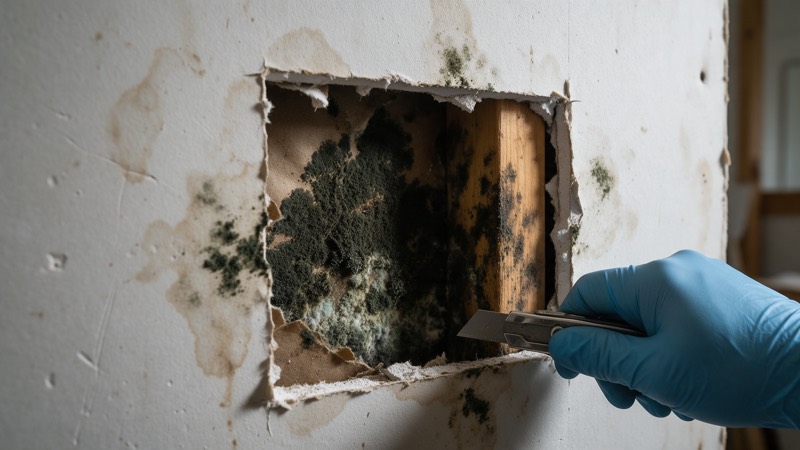
What you are really buying or not buying is the moisture source. Two square feet of growth from a bath fan that vents into the attic is a cheap fix. Two square feet at the bottom of a finished basement wall can be the visible edge of a wall cavity that gets wet every storm. Same size, very different house.
The checks you can run yourself at the second walk-through
Ask your agent to schedule a return visit during the inspection period. Bring a bright flashlight, an inexpensive pin-type moisture meter, and a hygrometer. None of this replaces a professional, but it turns a vague line in a report into something you can actually reason about.
- Start with your nose, before you open anythingWalk in, stop just inside the basement door, and breathe. A musty, earthy smell in a space with no visible growth is itself a finding: it usually means growth somewhere you cannot see, behind finish or under flooring. Note where it is strongest. Candles, plug-in fresheners, and fresh paint in only one room are worth noticing too.
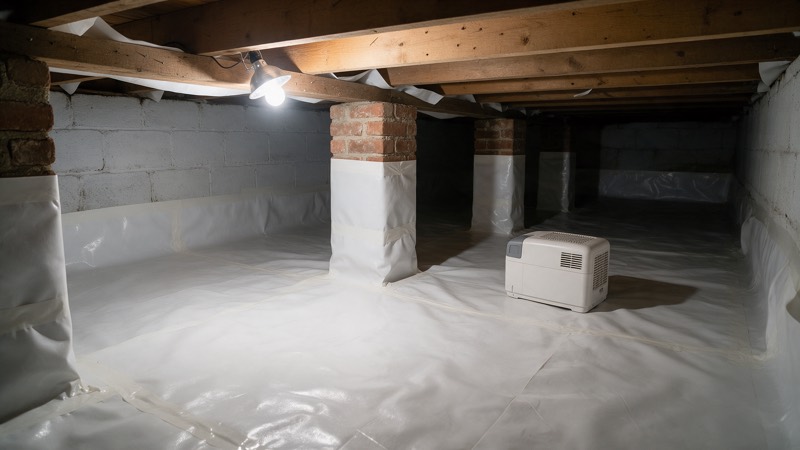
- Set the hygrometer down and leave itPut it on a shelf in the basement as you arrive and read it as you leave. Under 50% relative humidity is healthy. Sustained readings over 60% mean the space supports growth whether or not you see any. A dehumidifier running hard when you walk in tells you the seller already knows that.
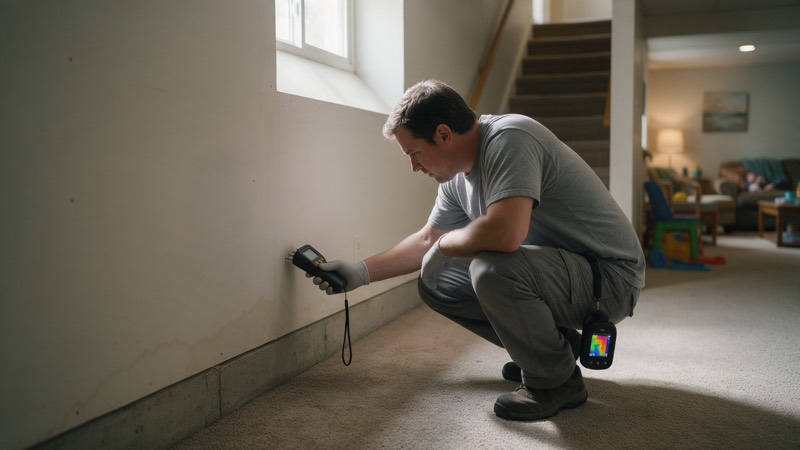
- Meter the low parts of below-grade wallsTouch the pins to drywall a few inches above the floor every few feet along exterior walls, and again around the area in the report. Compare against a reading on an interior wall upstairs. A wall that reads dramatically wetter than the dry baseline along its bottom edge is taking on water. Do not drive pins into anything you have not been given permission to mark; most sellers are fine with tiny pinholes, but ask through your agent.
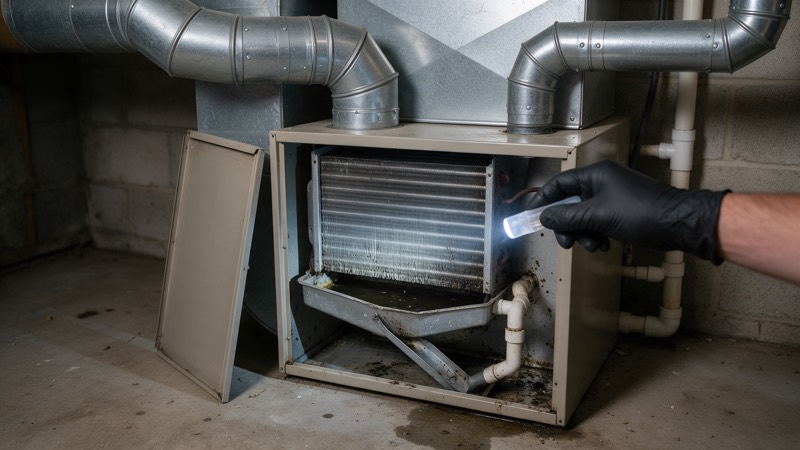
- Look where water travels, not just where the stain isUnder every sink, behind the toilet at the supply line, the ceiling below each upstairs bathroom, around the water heater and the HVAC air handler, the window sills on the north side. Fresh paint on a single ceiling patch or new baseboard in one corner of an otherwise old basement are classic places where a past leak was covered up.
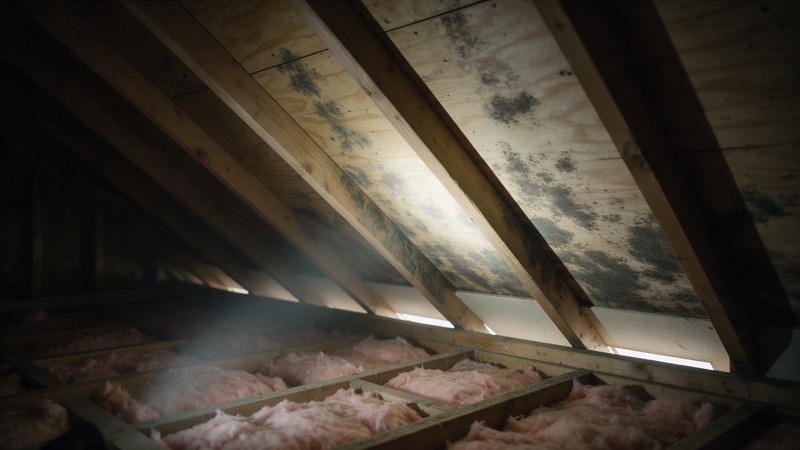
- Check the attic hatch with the flashlightLook at the underside of the roof deck near the bath fan and around any vent pipes. Gray or black speckling across the sheathing, frost marks, or a bath fan duct that ends loose in the insulation all point to a ventilation problem rather than a roof leak.
- Walk the outside of the houseDownspouts that dump against the foundation, soil sloping toward the house, a window well full of leaves, a sump discharge that empties three feet from the wall. These are cheap to fix and they are the usual reason a basement is wet.
- Photograph everything with something for scaleA tape measure or a dollar bill in frame. You will want these when you write your request, and if you end up in a dispute later, pictures from before closing are the only evidence of the condition you were sold.
Do not scrub, scrape, or open anything
It is not your house yet, and disturbing growth puts spores in the air for whoever is standing there. Look, measure, and photograph. Anything that needs a wall opened or a sample cut is the seller's permission and a professional's job.
Your own toolkit, and what it costs
This is the whole kit for a buyer's second visit. You will use the hygrometer for as long as you own the house, so it is not money spent on a deal that might not happen.
| Item | What it tells you | Typical cost |
|---|---|---|
| Bright LED flashlight | Raking light across a wall shows staining, bubbling paint, and patched drywall that overhead light hides. | $15–$30 |
| Hygrometer | Whether the space holds the kind of humidity mold needs, independent of any visible growth. | $10–$12 |
| Pin-type moisture meter | Whether a stained material is wet now or dried out years ago. | $25–$45 |
| Tape measure | Honest square footage, and scale in your photos. | $8–$15 |
Roughly $60–$100 for the full kit at any hardware store in the region. Typical range for this market — not a quote. Every property is different, and the number that matters is the written scope you get after the free inspection.
When the report is enough, and when you need a mold assessment
You do not need a mold specialist for every line item. If the finding is a small patch on a hard surface (a shower corner, a window sill, grout) and your meter says the surrounding material is dry, a general inspector's note and a repair request are usually enough.
Bring in a dedicated mold inspection when any of these are true:
- The growth is on drywall, subfloor, or insulation rather than a hard surface.
- Your meter or the inspector's found elevated moisture in a below-grade wall.
- The house smells musty and nobody can find the source.
- There is evidence of a past flood, a sump failure, or a fresh patch over an old stain.
- The finding is near the HVAC air handler, the return, or the ductwork.
- Your lender, your insurer, or you yourself will want a written assessment rather than a photo.
A good assessment answers three questions: how much of the building is affected, where the water is coming from, and what removal would involve. The third answer is what you negotiate with. A lab report that names a species, on its own, does not change the response; the material still comes out and the water still gets fixed.
What to actually ask the seller for
Once you know the size of the problem, you have roughly four options, and the right one depends on how much control you want over the work.
A credit at closing
The seller reduces the price or credits you at settlement, and you hire the remediation yourself after you own the house. This is usually the best option for a buyer: you choose the contractor, you control the scope, and you know the water source actually got fixed. Base the number on a written scope from a remediation company, not on a guess. Your lender has to approve credits, so involve your agent early.
Seller remediation before closing, with conditions
If the seller insists on doing the work, put conditions in writing: the work is done by a qualified remediation company rather than a handyman, the moisture source is identified and corrected, you receive the scope, invoices, and photos, and the result is verified by an independent clearance test from someone who did not do the remediation. Without that last condition, "remediated" can mean a coat of paint.
Escrow holdback
Some deals hold back part of the seller's proceeds in escrow until the work is done after closing. It is useful when timing is tight, but it needs your agent, the settlement company, and usually the lender to agree on terms. Ask about it rather than assuming it is available.
Walking away
If your contract has an inspection contingency and the findings point to an unresolved water problem the seller will not address, walking is a legitimate result. A house that gets wet every storm will keep doing it after you own it. Your agent and, if needed, a real estate attorney can tell you exactly what your contract allows and by when.
Ask what the seller already knows
Each jurisdiction in the DMV has its own seller disclosure form, and they differ in what they ask about past water and mold. Read what the seller checked, and ask in writing about past leaks, flooding, sump failures, insurance claims, and any earlier remediation. If there was earlier remediation, ask for the paperwork and the clearance report. A seller with documentation is a much better bet than one with a fresh coat of paint.
The DC rule that matters to buyers
In the District, the DC Mold Assessment and Remediation Act requires that mold assessment and remediation above roughly ten square feet be performed by professionals licensed by the Department of Energy and Environment. If you are buying in Washington DC and the seller offers to handle a larger area with their own crew, that is not just a quality concern. Ask for the licensed company's name and paperwork.
Virginia and Maryland do not license mold work specifically, so there the protection comes from your contract terms and from requiring independent verification. In Maryland, home improvement work generally falls under MHIC licensing, which is worth confirming for any reconstruction after removal.
What it costs: doing it yourself versus hiring it out
These are the typical ranges we publish on our service pages, set against what a buyer can reasonably handle on their own. Use them to sanity-check a seller's offer or a credit request, not as a quote: every house is different, and the written scope from an actual assessment is what your number should rest on.
| Situation | Doing it yourself | Hiring it out |
|---|---|---|
| Finding out whether there is a problem | $60–$100 for flashlight, hygrometer, and moisture meter | Visual inspection with moisture mapping is free |
| Suspected hidden growth, nothing visible | Your nose and a hygrometer, then stop | $350–$600 for air sampling with an outdoor control |
| Documentation for a lender, insurer, or negotiation | Your own photos help but will not be accepted alone | $500–$1,200 for a full written assessment |
| Small patch on tile, grout, or a sill (under 10 sq ft) | $60–$85 cleaning kit, after you own the house | $600–$1,500 contained |
| Growth on or behind drywall in one room | Not a DIY job | $1,500–$4,000 |
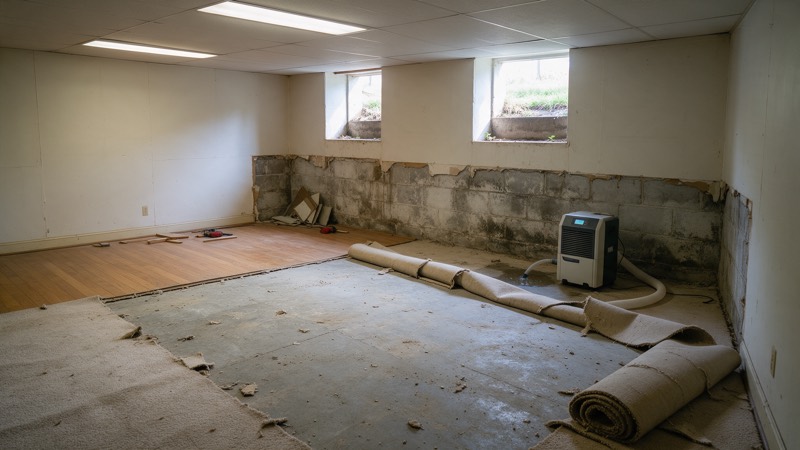
| Finished basement with water entry | Downspout extensions and regrading around $50–$200 in materials | $4,000–$12,000 for removal and drying, before reconstruction |
| Attic growth from a misrouted bath fan | Not a DIY job if the sheathing is affected | $350–$900 per fan to re-vent; $800–$2,000 for localized sheathing |
| Verifying the seller's remediation | Not possible to do yourself | $450–$800 for independent clearance testing |
Base any credit or holdback on a written scope, and remember the source repair (a sump, grading, a flashing) is often a separate line from the removal. Typical range for this market — not a quote. Every property is different, and the number that matters is the written scope you get after the free inspection.
The mistakes buyers make
- Accepting "it was cleaned" as a fix. Cleaning without fixing the water means the same growth returns. Ask what caused it and what was done about the cause.
- Letting the seller pick who verifies. Clearance testing has to come from someone independent of the company that did the work.
- Negotiating on a guess. A credit request built on a written scope is hard to argue with. A round number pulled from a forum is easy to.
- Skipping the second visit. The inspection is often the only time you will see the basement before settlement. Go back with your own meter while you still have leverage.
- Ignoring the smell because the walls look fine. Fresh paint and new baseboard can hide a lot. Odor cannot be painted over.
- Running out the clock. Contingency deadlines are set by your contract, not by how long a mold assessment takes to schedule. Book the specialist the day you read the report.
Your first month after closing
Whatever you negotiated, a few habits in the first weeks will tell you whether the problem is really solved. Leave the hygrometer in the basement and check it after the first heavy rain. Extend every downspout at least a few feet from the foundation if the seller did not. Test the sump by pouring a bucket into the pit and watching it cycle. Run bath fans for twenty minutes after every shower, and confirm they actually exhaust outdoors rather than into the attic.
If you cleaned a small hard-surface patch yourself, the method in our DIY mold playbook applies. If anything returns within a few weeks, that is the water source telling you it was never found.
Where you stop
As a buyer, your job before closing is to observe and document, not to fix. Stop and bring in a professional when:
- The affected area is bigger than about ten square feet, or you cannot tell how big it is.
- It is on or behind drywall, insulation, or subfloor.
- Below-grade walls read wet on your meter.
- The smell is strong and nothing visible explains it.
- Anyone who will live in the house is immunocompromised, pregnant, asthmatic, or an infant.
- You need a document a lender, insurer, or attorney will accept.
Before your contingency runs out, get the size of the problem in writing
The worst outcome is closing on a finding nobody measured. If the report flagged mold and you are inside your inspection period, call 202-798-7663 or book a free visual inspection with moisture mapping at calendly.com/karmacgroup/30min. We will tell you honestly whether it is a weekend job or a negotiation, and if it is the second, our remediation and basement pages explain what the work involves.
Not sure which side of the line you are on?
The inspection is free and we will tell you honestly if it is a job you can do yourself.