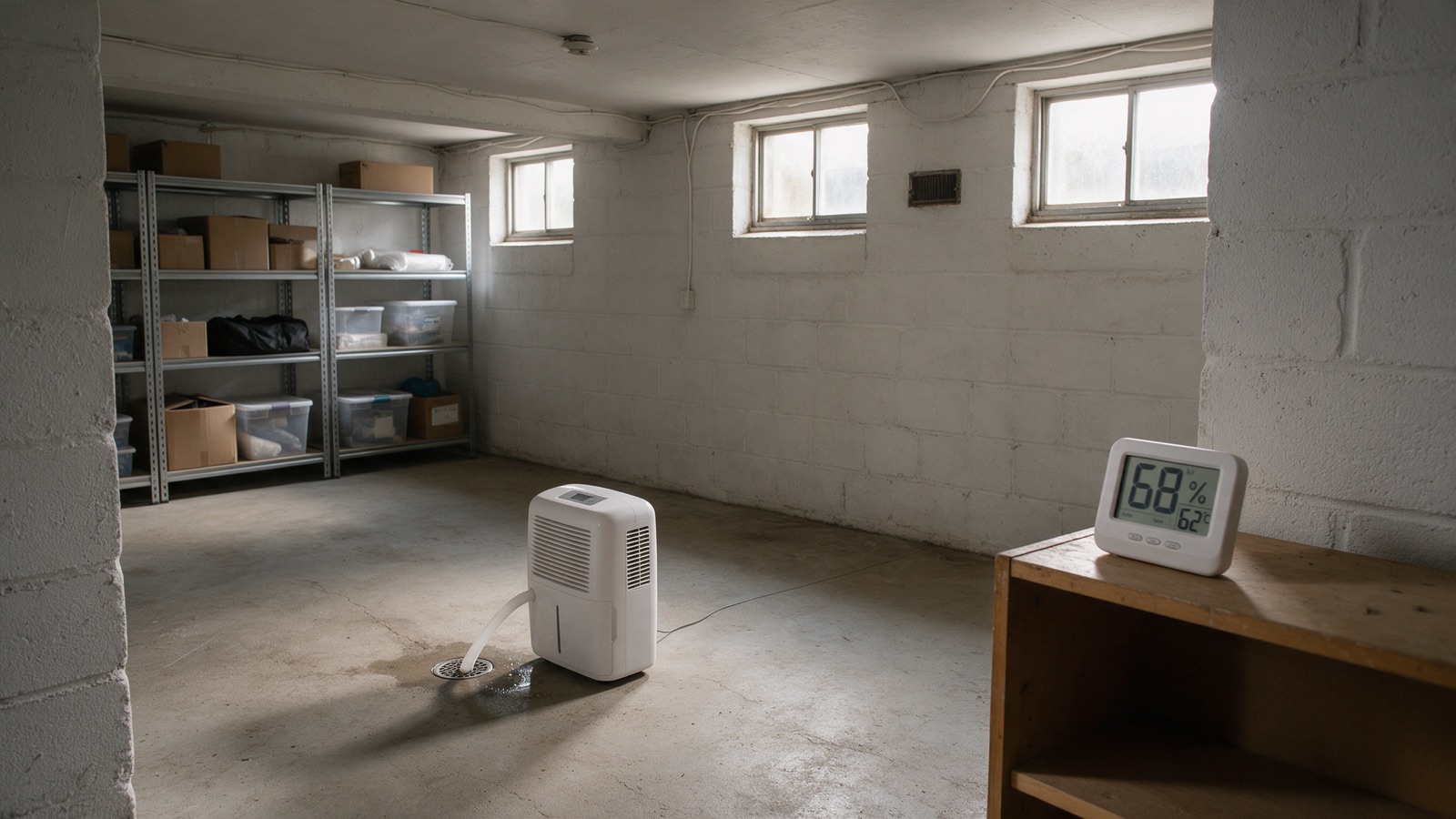
The Cheapest Tool That Prevents Most Basement Mold in the DMV
A dehumidifier is not exciting, and a hygrometer is less exciting still. We would rather tell you about thermal cameras and negative air machines, because that is the interesting part of our work. But if we could put one thing in every basement in DC, Northern Virginia, and Maryland, it would be a small digital humidity gauge from the hardware store, plus the habit of looking at it. It prevents more of the jobs we get called to than anything we sell.
Why basements here grow mold without a single leak
People expect mold to follow water they can see: a burst pipe, a storm, a sump that quit. Plenty of it does. But a large share of the basement growth we find in this region has no leak behind it at all. The cause is the air.
Mid-Atlantic summers are long and humid. Warm outdoor air carries a lot of moisture, and when it drifts into a basement, it meets block walls and a slab that sit at ground temperature, well below the air outside. Cooler air holds less water, so the relative humidity climbs. A basement can sit in the high sixties or seventies for months while every pipe in the house is perfectly dry. Cardboard boxes, the paper face of drywall, carpet pad, and the dust on the back of stored furniture all become food in that environment.
The other half of the story is that you cannot feel it. A basement at seventy percent humidity in July feels cool and pleasant when you walk down from a hot kitchen. Nothing about it tells you there is a problem until the smell arrives, and by then something is already growing.
The numbers that matter
The EPA recommends keeping indoor relative humidity below 60%, ideally between 30% and 50%. Mold spores are in every house in this region, and that is normal. What you control is whether they find conditions to grow in, and sustained humidity is the condition that matters most.
| Your basement reads | What it means | What to do |
|---|---|---|
| Under 50% | Dry enough. Growth struggles to establish. | Nothing beyond checking it now and then. |
| 50–60% | Borderline. Fine for a while, risky as a summer-long average. | Watch the trend and close up obvious air leaks. |
| 60–70% | Growth territory, especially on cardboard and paper-faced drywall. | Run a dehumidifier set to 45–50%. |
| Over 70% and staying there | Usually a moisture source, not just weather. | Dehumidify, and go looking for where the water is coming from. |
The word that matters in that table is sustained. A reading of sixty-five after a rainy afternoon is not an emergency. A basement that averages sixty-five across June, July, and August is how musty smells start.
Choosing a hygrometer, and checking that it tells the truth
Any inexpensive digital unit that shows both temperature and humidity is fine. Pick one that records the high and low since it was last reset, because a single glance tells you very little and the overnight peak tells you a lot. Some models log to a phone app, which is handy for seeing a week at a time but not necessary.
Budget gauges can drift by a few points, which matters when your decision line is sixty. You can check one at home with the salt test. It costs almost nothing and it works because a damp salt slurry holds the air above it at a known humidity, about 75%.
- Make a damp salt pastePut a few tablespoons of ordinary table salt in a bottle cap or small dish and add just enough water to make it look like wet sand. No standing water.
- Seal it in with the gaugePut the dish and the hygrometer together in a zip-top bag, press out most of the air, and seal it. Keep it somewhere the temperature stays steady, away from a window.
- Wait overnightGive it at least eight hours, longer if you can. The air in the bag needs time to settle.
- Read the differenceThe gauge should read close to 75%. If it shows 71%, it reads four points low, so add four to everything it tells you from now on. Write the offset on a piece of tape on the back.
Where to put it
Mount it at about chest height in the middle of the basement, not on an exterior wall, not next to the dryer, and not right beside the dehumidifier. You want a reading of the room, not of one corner.
Read it for a week before you buy anything
The gauge is cheap. The machine is not. Before you spend real money, take a week of readings and write them down: morning and evening, plus the daily high if your unit records it. Note the weather alongside.
Three patterns tell you different things. Readings that climb on humid days and fall on dry ones mean outdoor air is the driver, and a dehumidifier will handle it. Readings that jump after rain, especially a day or so later, point to water moving through the foundation, which a dehumidifier will only mask. Readings that are high in one corner and normal elsewhere point to a local source: a dryer vent that is disconnected, a sweating cold-water line, a crack, or a window well full of leaves.
Sizing a dehumidifier without overbuying
Portable dehumidifiers are rated in pints of water removed per day. Two things trip people up when shopping.
First, the rating standard changed. The Department of Energy updated its test procedure several years ago to measure at cooler, more realistic basement conditions, so units are now rated lower than the same machine would have been under the old method. A unit sold today as 50-pint is roughly what used to be labelled a 70-pint. If you are comparing against an old machine or an old forum post, keep that in mind.
Second, bigger is not automatically better, but too small is a real failure. An undersized unit runs nonstop, never reaches its setpoint, and wears out early. For most basements in this region:
- Up to about 1,500 square feet and humid but not wet: a 50-pint unit (current rating) is usually enough.
- Larger, or already smelling musty, or with visible damp spots on the slab: step up to a larger portable or consider a ducted whole-basement unit.
- A space you never use and do not want to think about: pay for a model with a built-in pump or gravity drain connection. Convenience is what keeps it running.
Look for the Energy Star label. A dehumidifier in a Mid-Atlantic basement may run for a good part of the year, so efficiency adds up on the electric bill.
Setting it up so it actually works
- Set it to 45–50%Lower than that wastes electricity and can make wood trim and floors shrink. Higher than that leaves you near the line.
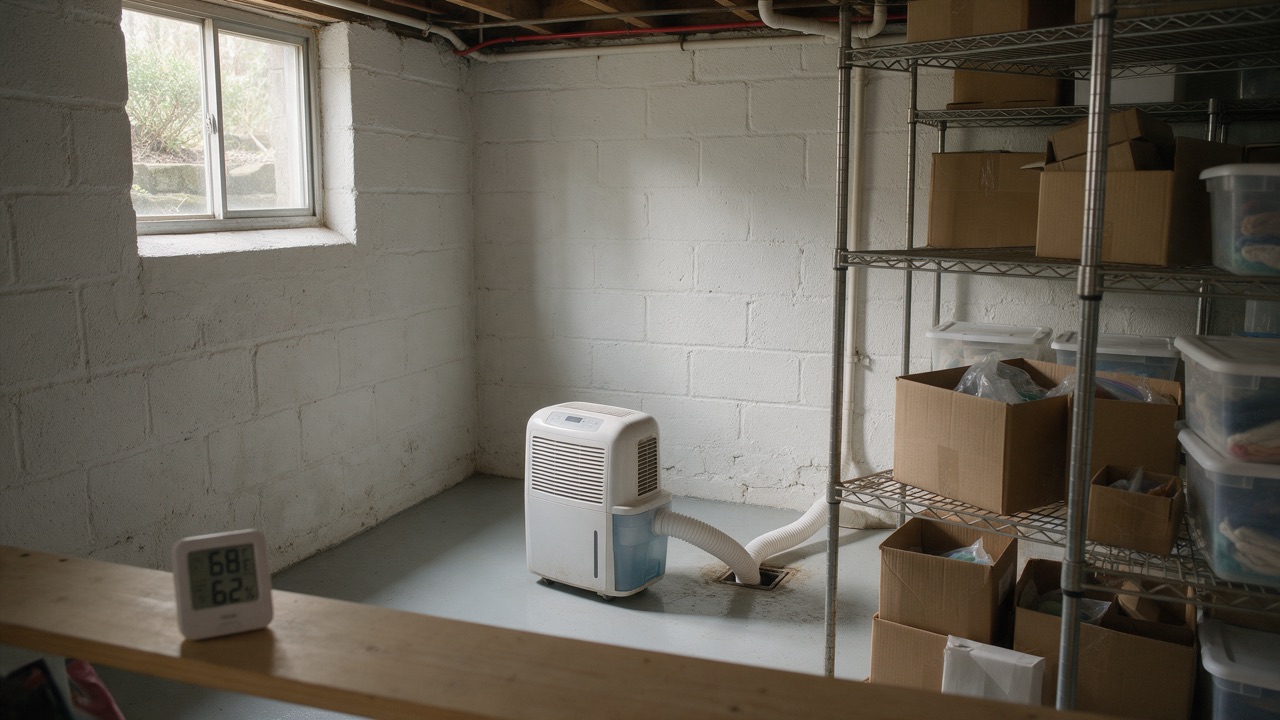
- Drain it continuouslyRun the hose to a floor drain, a sump pit, or a laundry sink. If the unit sits lower than the drain, buy a model with a pump. Relying on someone emptying a bucket is the weak link in almost every setup we see.
- Give it room to breatheKeep it at least a foot off the walls, in open floor, with doors to the rest of the basement open so it is drying the whole space and not one closet.
- Close the basement upShut basement windows in summer, even though it feels backwards. Opening them on a humid day imports the moisture you are paying to remove.
- Clean the filter monthlyA clogged filter cuts airflow and the unit ices up or cycles badly. Rinse it, let it dry, put it back.
- Keep reading the gaugeYour hygrometer is the check on the machine. If the unit says 45% and the gauge says 62%, believe the gauge and find out why.
Do not run it into a floor drain that backs up
If your floor drain has ever pushed water up during a storm, do not rely on it as your only outlet. Use the sump pit or a condensate pump to a sink instead, so a backup does not put water on the floor the machine is trying to keep dry.
Free fixes that take load off the machine
A dehumidifier treats the air you already have. These reduce how much wet air gets there in the first place, and none of them cost much beyond an afternoon.
- Check the dryer vent. Follow the duct from the back of the dryer to the outside. A loose connection behind the machine dumps warm, wet air straight into the basement every load.
- Insulate cold water lines. Pipes that sweat in summer drip onto whatever is below them. Foam pipe sleeves stop it.
- Get stored things off the floor and away from walls. Plastic bins instead of cardboard, on shelves, a few inches from the block.
- Clear the window wells. Leaves and soil hold water against the window frame and the wall around it.
- Walk the outside after a storm. Downspouts that dump next to the foundation and soil that slopes toward the house put water against the wall that eventually comes through it as humidity or seepage.
What it costs
This is one of the clearest cases on our site where doing it yourself is the right answer for most people. The professional rows below apply when the reading is high because of water, not weather, or when the space is a crawl space rather than a basement you can stand in. Professional figures match the typical ranges on our service pages.
| Situation | Doing it yourself | Hiring it out |
|---|---|---|
| Knowing your humidity | $10–$15 digital hygrometer; salt test costs almost nothing | Visual inspection with moisture mapping: free |
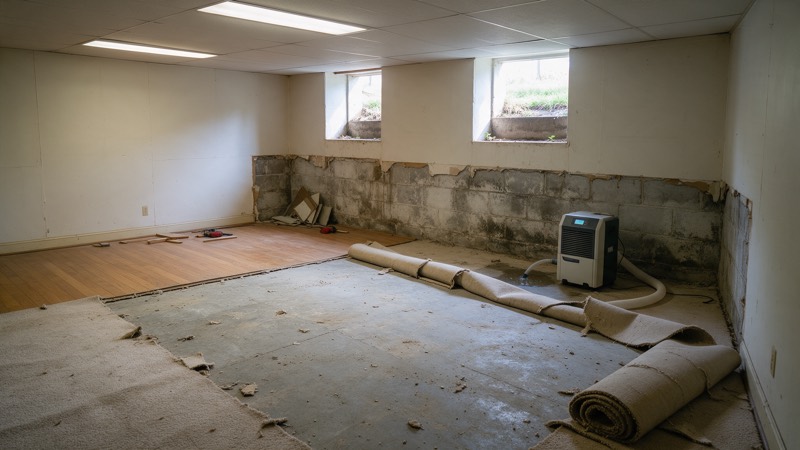
| Humid basement, no leak | $200–$350 for a 50-pint Energy Star portable | Usually not needed |
| Portable with a built-in pump | $250–$450 | Usually not needed |
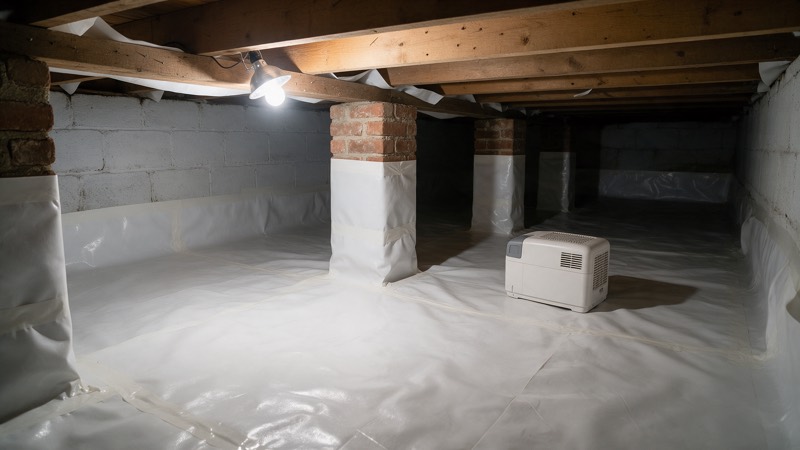
| Crawl space too damp to manage | Close vents in summer, check the vapor barrier | $1,200–$2,800 for an installed crawl space dehumidifier |
| High readings after every rain | Downspout extensions $10–$25 each; regrade soil yourself | $3,000–$15,000 for interior drainage and grading correction |
| Musty smell and growth already behind a finished wall | Not a DIY job | $1,200–$3,000 for one section; $4,000–$12,000 for a full finished basement |
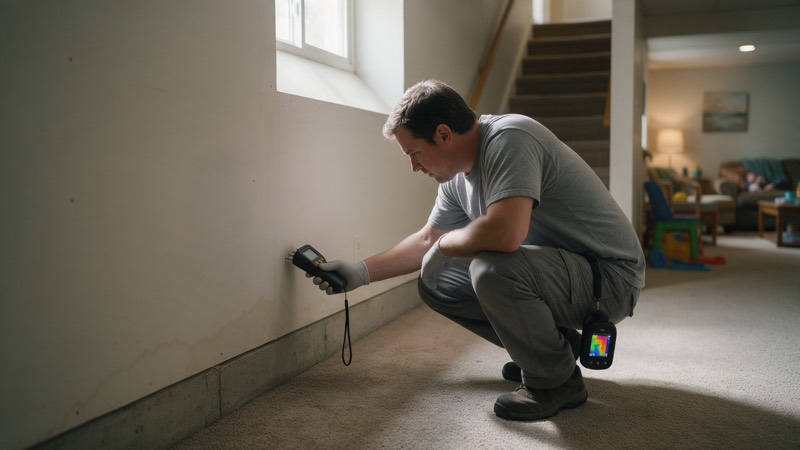
| Unsure whether something is growing | Track readings and smell for a week | $350–$600 for air sampling with an outdoor control |
Electricity to run a portable unit adds to the bill as well, and depends on your rate and how many hours it runs. Typical range for this market — not a quote. Every property is different, and the number that matters is the written scope you get after the free inspection.
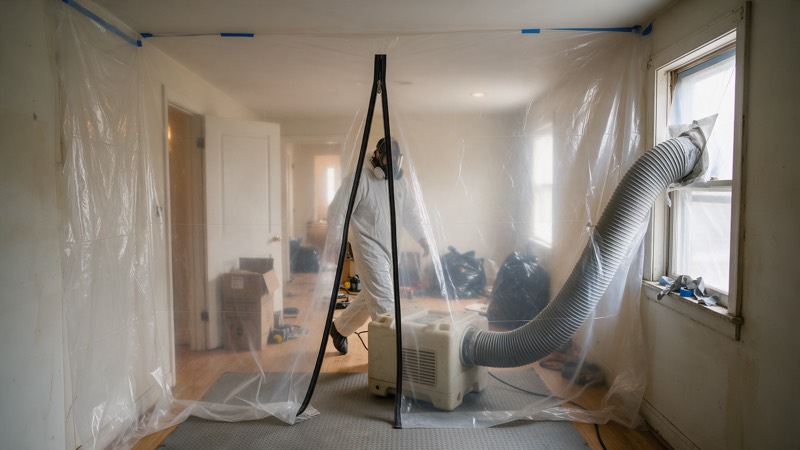
For a basement with growth already established or a crawl space, the cost is mostly in removing material that cannot be cleaned and fixing the path water takes in. A dehumidifier is part of the answer there, not all of it.
When the number is telling you something worse
Humidity control prevents mold. It does not remove mold that is already established, and it does not fix water that is coming in. These are the signs that you have moved past a gauge-and-machine problem:
- The dehumidifier runs constantly at the right size and the gauge still will not come below sixty.
- Readings spike a day or two after heavy rain.
- There is a white, chalky crust on the block (efflorescence), damp patches on the slab, or water at the wall base.
- The basement still smells musty after a few weeks at a good reading.
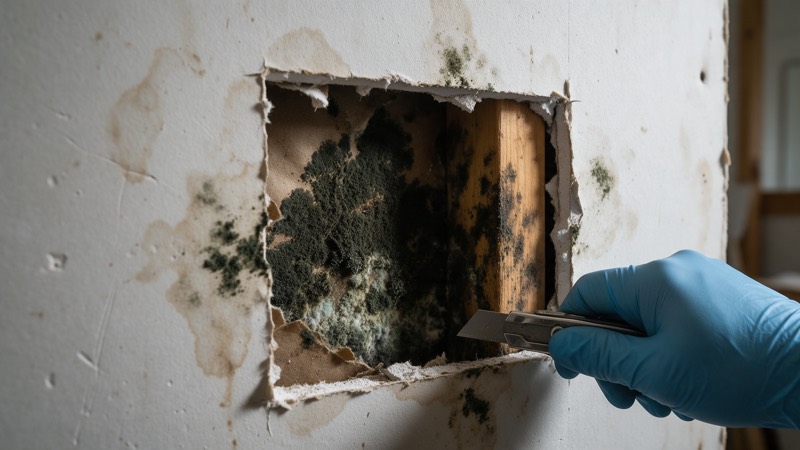
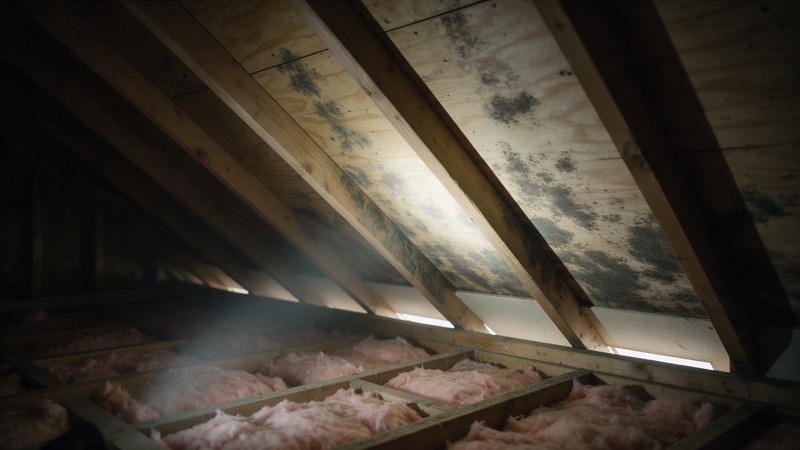
- You can see growth on drywall, paneling, carpet, or the bottom of stored furniture.
- Somebody in the house notices symptoms that ease when they leave. That is a question for their doctor, and a good reason to get the building checked too.
Where you stop and call
If the smell persists at a good humidity reading, if growth covers more than about ten square feet, if it is on or behind drywall or carpet, or if water is coming through the foundation, the dehumidifier is no longer the fix. Do not scrub or tear it out yourself. Call 202-798-7663 or book a free inspection, and we will find where the moisture is coming from before anyone talks about remediation.
The regional footnote
A few things make this more pressing here than in drier parts of the country. Rowhouses across DC and older homes in inner Maryland often have finished space built tight against uninsulated masonry, which stays cold and pulls humidity up at the wall surface. The clay soils common in Northern Virginia hold water against foundations rather than draining it away. And our humid season is long enough that a basement can spend most of the year above the line without anyone noticing.
None of that makes the fix complicated. Buy the gauge, check it with salt, read it for a week, and size the machine to the space. For most basements in this region, that is the whole job.
Not sure which side of the line you are on?
The inspection is free and we will tell you honestly if it is a job you can do yourself.